Concrete Slabs Built to Stay Level
Concrete Services in Missoula for cracked driveways, settling walkways, and patios that have deteriorated through freeze-thaw cycles
What remains after concrete work is completed—a driveway that drains correctly, a walkway without trip hazards, a patio slab that sits flat and stable—reflects decisions made well before the pour. DML Construction LLC provides concrete installation services in Missoula for driveways, slabs, patios, walkways, and other residential concrete projects where the quality of subgrade preparation and mix design determines how the finished surface performs over time. Homeowners who have watched previous concrete crack, heave, or sink within a few years are often dealing with the consequences of steps that were skipped before the concrete was placed.
Concrete in Montana faces conditions that accelerate failure when the work isn't done correctly from the start. Freeze-thaw cycles apply mechanical stress to slabs repeatedly each winter, and concrete that was placed over poorly compacted subgrade, poured too thin, or finished without control joints in the right locations will crack along predictable lines. In Missoula, soil conditions vary enough between sites that subgrade preparation isn't a standardized process—fill depth, compaction method, and whether base material needs to be imported all depend on what the existing ground conditions show before forming begins.
Request a site visit to assess existing conditions and determine what subgrade preparation your specific project will require before forming or pouring begins.
What You Notice Once the Concrete Work Is Finished
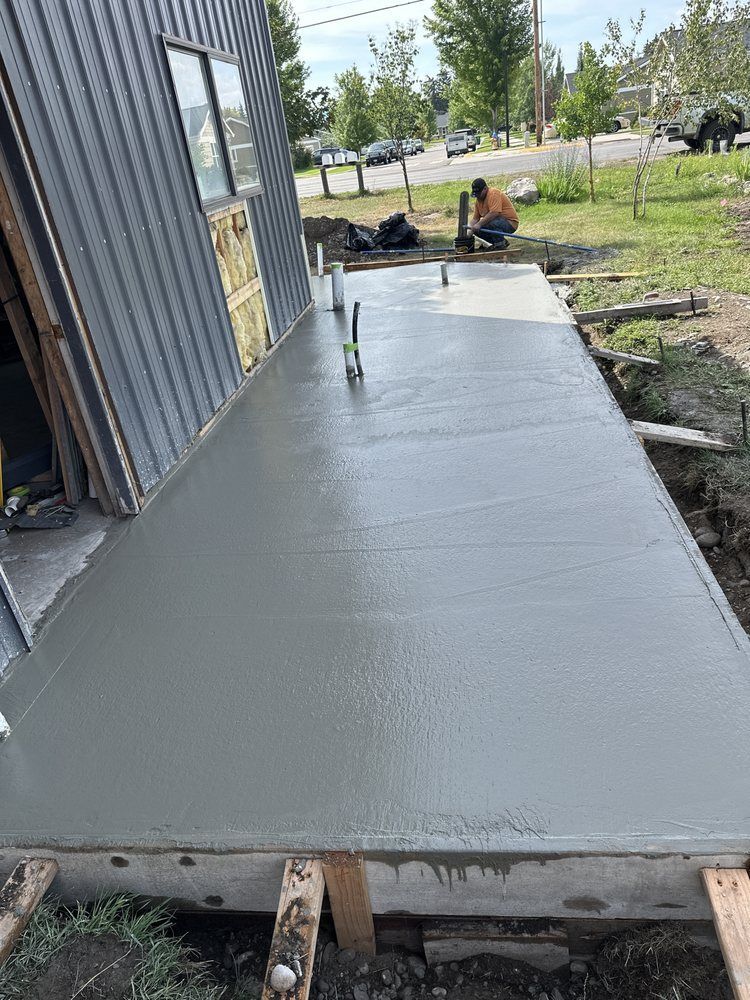
Concrete installation begins with subgrade work: existing material is excavated to the required depth, base gravel is placed and compacted in lifts, forms are set to the correct grade for drainage, and reinforcement is positioned before the pour. Control joint placement is planned before concrete is placed—not cut randomly after the fact—because joints are intentional weak points that direct cracking to locations where it won't compromise the slab's function or create trip hazards. The mix design, water-to-cement ratio, and finishing timing all affect the surface durability and how the slab will hold up through its first Montana winter.
After the concrete has cured, the finished surface is flat with consistent slope away from structures, edges are defined and clean, and control joints run in straight lines at planned intervals rather than appearing as random cracking. Driveways handle vehicle loading without deflection, walkways present an even surface without lips or low spots where water collects and freezes, and patios drain toward the yard rather than back toward the foundation. These are measurable, observable results that distinguish properly placed concrete from work that passes visual inspection initially but fails within a season or two.
Project scope varies based on what's being replaced or installed, site access, total square footage, and whether existing concrete needs to be removed and hauled before new work begins. Decorative finish options—broom texture, exposed aggregate, or stamped patterns—are decisions that affect both the finishing process and long-term maintenance requirements, so those choices are best made during planning rather than at the time of the pour. DML Construction LLC works through those decisions with homeowners before the project starts so there are no surprises during construction.
Answers to Frequent Concrete Service Questions
Concrete projects generate practical questions about timing, thickness, and what makes one installation last longer than another. The following covers what comes up most often on residential concrete work in Missoula.
Why does concrete crack even on new installations?
Concrete shrinks slightly as it cures, and without properly spaced control joints to direct that movement, cracks form wherever internal stress finds the path of least resistance—which is rarely a straight, predictable line.
How thick does a residential concrete slab need to be for driveways versus walkways?
Driveways that carry vehicle loads typically require greater thickness and reinforcement than pedestrian walkways; the specific requirements depend on expected load, soil bearing capacity, and whether the subgrade is undisturbed native soil or compacted fill.
When is the right time of year to pour concrete in Missoula?
Concrete placed in temperatures approaching freezing requires protection from cold and may need accelerators or heated water to cure correctly—spring through fall typically provides the most reliable conditions, though cold-weather placements can be managed with proper precautions.
What causes a concrete driveway or patio to sink or heave after installation?
Settlement usually traces back to subgrade that wasn't compacted adequately before the pour; frost heave results from moisture in the subgrade freezing and expanding, which lifts slabs that don't have sufficient depth below the frost line.
How do I evaluate whether existing concrete needs replacement or can be repaired?
Cracks that are wider than a quarter inch, sections that have heaved relative to adjacent slabs, or surface spalling that has exposed aggregate across large areas generally indicate that repair won't produce durable results and replacement is the more cost-effective path.
DML Construction LLC approaches concrete projects with the same attention to subgrade and formwork that determines long-term performance—not just how the surface looks the day the forms come off. To discuss your driveway, patio, or walkway project in Missoula, call (406) 677-1772 to set up a site assessment.